

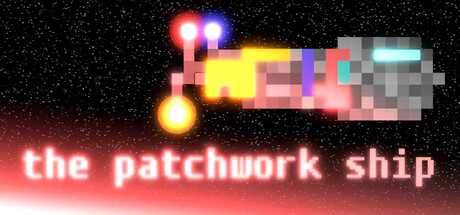
The Patchwork Ship
A spacecraft survival deckbuilder where you assemble devices from salvage, keep memories and schematics across runs, and partner with companions to escape a dying binary star system. For fans of Slay the Spire strategy and FTL’s storytelling, but without the micromanagement.
Does this feel indie?
Vote based on whether this game feels indie to you. You can change your vote at any time. Results earn an IGF score after 10 accepted votes.| ContextThe evidence factors used to assess whether this game belongs on IndieGame.Fan. | Status | Notes Latest Contributor: IGF TeamEdit notes |
|---|---|---|
Media
6 itemsAbout the Game
The Patchwork Ship is a spacecraft survival deckbuilder. As a brain-in-a-box spacecraft, you must evolve, grow, and collaborate with others to escape a dying star.
Biologically, your brain is human, but lacks any memories or sense of when you were anything other than in this form.
You emerge from a manufacturing facility as a newly minted craft into a debris field filled with derelicts; something is very wrong. As you explore, you find schematics that permanently teach you to assemble salvage into devices that improve your craft, providing defense, offense, sensors, and more.
Each device offers either passive or active abilities and has an energy cost; active abilities are “played” as cards, and your cognitive capabilities limit the number of cards you can handle at a time (hand size). When cards are played, they are used and must be regenerated at a cost from any active device that is on.
Encounters, either probability-based or conflict-based, are conquered through the strategic application of your abilities. Hidden paths may be unlocked. You gain energy and scrap by finding resources (larger one-offs), defeating hostile enemies and reclaiming a portion of their energy (medium, variable efficiency), or through passive collection (provides a baseline, but unsustainable on its own).
Your core memories and any learned schematics are automatically backed up after each encounter. If you are destroyed, your memories are imprinted onto a new brain-in-a-box.
Over time, you recognize that no one is in control, no supplies or help are coming, and the environment is too hostile to stay. The only way to survive is to leave. At the apex of an environment, you find a gatekeeper guarding a transit gate; once conquered, you access another locale.
Survival requires networking, sharing knowledge, and trading; a lone path is difficult. A successful escape with any remaining survivors sends your band hurtling into the unknown, but away from danger.