
...INDIE
Sunder
Sunder is an orbital-artillery RTS in a living star system. Every world is a gun platform on a moving orbit: bend shots around the sun, shove planets off their rails, and crack rival worlds to the core. Draft your arsenal as you fight — solo skirmishes or online war with up to 8 players.
Developer
Publisher
Release
Coming Soon
Steam Reviews
No reviews yet
Game contextLatest: IGF Team
| ContextThe evidence factors used to assess whether this game belongs on IndieGame.Fan. | Status | Notes Latest Contributor: IGF TeamEdit notes |
|---|---|---|
Media
6 itemsAbout the Game

Sunder is a real-time strategy game fought inside a working solar system. Every weapon is real ordnance on a real trajectory, bent by the sun's gravity on the way to its target. Nothing on the map ever holds still — firing lines open and close as the worlds orbit, and the shot that was blocked ten seconds ago is now a clean kill.
Take worlds. Arm them. Aim well. Last until everyone else is rubble.
Every Shot Is a Gravity Problem
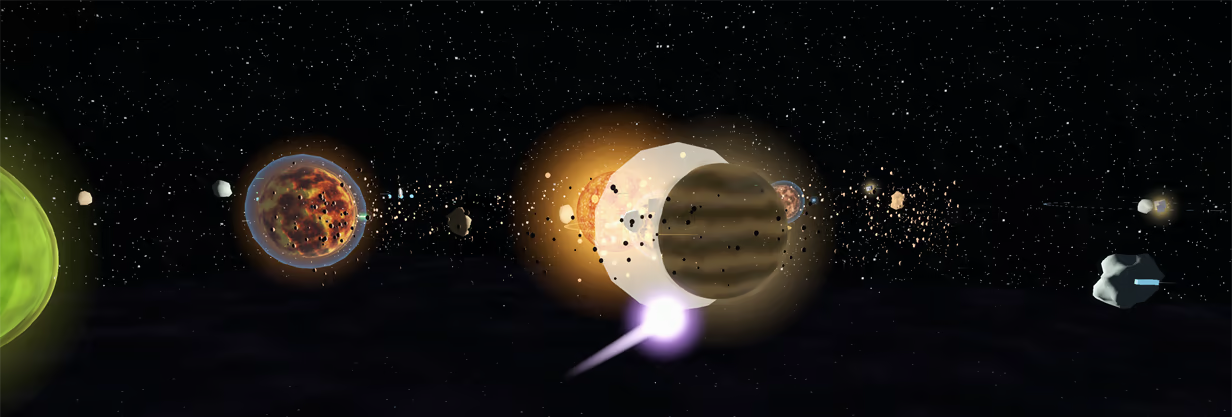
There is no hitscan in Sunder. Railgun slugs fly flat and fast. Mortars climb over planets and drop on the far side. Slingshot torpedoes dive at the star and ride its pull into arcs nothing else can throw. Planets block shots, asteroids wander into firing lanes, and projectiles that miss their target keep flying until something stops it. The aim preview shows you the curve — predicting trajectories is the skill the whole game is built on.
The map itself is ammunition. Embed a thruster charge to shove a rival planet off its rail. Fire your own planet's engines to dodge a volley. Tractor an asteroid and sling it. Drop a gravity well in open space and bend every shot in flight — yours and everyone else's — or open a wormhole and shoot through it.
An Arsenal of Sidegrades
A deep rack of weapons, and not a single straight upgrade among them. Every gun trades the same brutal efficiency for a different shape of violence: an autocannon burst that walls off incoming fire, a swarm cloud that drowns point defense, a drift mine that floats out quiet and locks in place, a nuke that catches several worlds in one sunrise. Shots have mass and meet each other mid-air — a volley can be intercepted, a torpedo flak-gunned, a nuke shot down. It detonates where it dies, so even that might not save you.
Draft as You Fight
Matches run as short rounds in a series. You bring one weapon and your doctrine; everything else comes from drafts between rounds — a pool of boons holding new weapons, new abilities, stackable upgrades, and legendaries that change the rules outright. Two commanders with the same doctrine rarely end a series playing the same game.
Worlds Don't Just Fall. They Come Apart.
Strip a world's shield and its crust cracks open — a glowing seam of exposed core, half its output gone, every rival watching. Its owner can fight to re-seal the breach. Or you can finish the job and blow the planet into a debris field that tumbles through the system, chipping at everything it touches. Matches escalate toward sudden death; nobody turtles forever.
Hold the System
Under the artillery sits a full strategy layer. Worlds store charge for their guns and earn credits for the build queue: reactors and capacitors to fire harder, shield generators and bastion fields to take a beating, mining lasers and trade routes for income — and trade can be raided, so income is never safe. Commission carrier fleets, kit their wings for interception, bombing or piracy, and command them like any RTS. Capture derelict hulks and abandoned stations for bonuses.
The system fights back. Solar flares, meteor storms, ion storms, gold rushes, pirates with no respect for borders, comets, binary stars with worlds of their own, the occasional roaming black hole. Rivals offer truces and let them expire at the worst possible moment. Every map is generated fresh, from tight clusters to wide expanses — you learn principles, not layouts.
Ways to Play
Classic conquest, a faster blitz, a timed score race, king of the hill over an anchored station, and a survival gauntlet against a rising tide. Then bend the rules with match modifiers:
Swelling Sun — the star grows all match, bending shots ever harder and devouring whatever it reaches. Race the clock.
Chaos — random events strike far more often.
Random Arsenal — your weapons re-roll every round. Adapt or lose.
Endless — the series never ends and the enemy keeps scaling. See how long you last.
…plus gentler dials — comeback aid, reinforced worlds, a slower pace, an aim preview that marks exactly where your shot will land — for learning the orbits without being executed for it.
Solo or Up to 8 Players
Skirmish against AI that gets better, not richer: harder difficulties aim tighter, react faster and coordinate against you — they never take a free credit. Or go online with up to 8 players: free-for-all, teams, or co-op against the machines. Drop-outs hand their seat to an AI mid-match and can rejoin the same war later; the fallen spectate, then draft with everyone else between rounds.
YouTube Videos
Most viewedNo videos are available for this game yet.
User Comments
Join the conversation in this game’s community chat.