

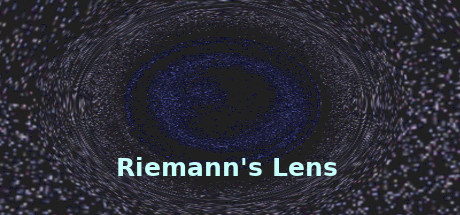
Riemann's Lens
Explore a wormhole! Riemann's Lens simulates the non-euclidean geometry and strange visual effects associated with a Riemannian wormhole. This interactive virtual art display allows you to fly around and through the wormhole.
Developer
Publisher
Release
May 12, 2022
4 years and 83 days ago
Steam Reviews
1 user reviews1 reviews0.0%
Does this feel indie?
Vote based on whether this game feels indie to you. You can change your vote at any time. Results earn an IGF score after 10 accepted votes.No votes yet
Game contextLatest: IGF Team
| ContextThe evidence factors used to assess whether this game belongs on IndieGame.Fan. | Status | Notes Latest Contributor: IGF TeamEdit notes |
|---|---|---|
Media
14 itemsAbout the Game
Explore a wormhole!
Riemann’s Lens simulates the non-euclidean geometry and strange visual effects associated with a Riemannian wormhole. While it is unknown whether these objects exist in nature, nothing prevents us from investigating their properties and consequences with our computers.
Riemann’s Lens is an interactive virtual art display that allows you to fly around and through a wormhole, with simple scenery rendered in the euclidean space on either end. The size and geometry of the wormhole can be adjusted.
Custom scenery can be defined with a scripting language.
The simulation uses a compute shader to perform non-euclidean ray-tracing, and relies on the graphics card to perform some heavy computations. It has been developed on a machine with a GeForce GTX 1650, and it manages 2-5 fps. Expect some lag. The graphics card must support OpenGL 4.3+, and compute shaders. It did not run on an Nvidia Quadro K1100M (6 year old laptop).
Riemann’s Lens simulates the non-euclidean geometry and strange visual effects associated with a Riemannian wormhole. While it is unknown whether these objects exist in nature, nothing prevents us from investigating their properties and consequences with our computers.
Riemann’s Lens is an interactive virtual art display that allows you to fly around and through a wormhole, with simple scenery rendered in the euclidean space on either end. The size and geometry of the wormhole can be adjusted.
Custom scenery can be defined with a scripting language.
The simulation uses a compute shader to perform non-euclidean ray-tracing, and relies on the graphics card to perform some heavy computations. It has been developed on a machine with a GeForce GTX 1650, and it manages 2-5 fps. Expect some lag. The graphics card must support OpenGL 4.3+, and compute shaders. It did not run on an Nvidia Quadro K1100M (6 year old laptop).