

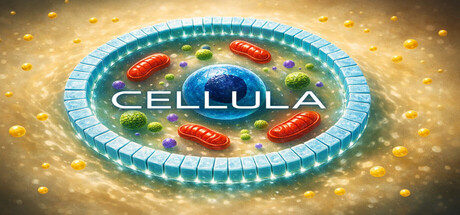
Cellula
Manage a colony of living cells in a strategy game built from real biology. Build phospholipid membranes, place organelles, import nutrients, fight viruses, detect cancer, and divide your cells to grow. No tutorials. No lectures. Learn by keeping the cell alive.
Does this feel indie?
Vote based on whether this game feels indie to you. You can change your vote at any time. Results earn an IGF score after 10 accepted votes.| ContextThe evidence factors used to assess whether this game belongs on IndieGame.Fan. | Status | Notes Latest Contributor: IGF TeamEdit notes |
|---|---|---|
Media
7 itemsAbout the Game
Cellula is a cell biology simulator disguised as a strategy game.
Manage a colony of living cells. Build membranes from individual phospholipid bricks, place organelles, import nutrients, fight viruses, detect cancer, and divide your cells to grow.
No tutorials. No lectures. Learn real biology by keeping your cells alive.
WHAT YOU'LL DO
Start with a single cell: a ring of phospholipid bricks that self-assembles through physics. Place GLUT1 transporters to import glucose, amino acid transporters to support protein production, and lipid transporters to grow your membrane. Build mitochondria to produce ATP, ribosomes to synthesize proteins, and lysosomes to break down waste. Grow your membrane by purchasing phospholipids from the Smooth ER. Use the Golgi apparatus to ship resources between cells.
Then biology fights back.
Viruses drift toward your cells and dock on the same transporters you built to feed them. They inject viral DNA, which slithers toward the nucleus. If it reaches its target, your cell becomes a virus factory and eventually bursts, releasing more viruses into the plasma.
Cancer can emerge after cell division. A dark, unstable nucleus begins growing beyond normal control and threatens the colony. Summon T-cells to hunt cancer, deploy B-cells to produce antibodies, or trigger apoptosis to sacrifice a doomed cell before it destroys everything around it.
Every lesson is learned through failure. Your cells will die of waste toxicity because you forgot lysosomes. Your colony will collapse because you placed too many transporters and gave viruses easy entry. You will learn what every organelle does, not because the game told you, but because your cells could not survive without them.
KEY FEATURES
Real Cell Biology — Every system is based on actual cellular mechanics: surface area-to-volume ratio, membrane transport, metabolic waste, viral entry, immune response, and cancer development
Physics-Based Membrane — Build your cell wall from individual phospholipid bricks that self-assemble, attract and repel each other, and can be clicked and dragged
Complete Organelle Economy — Mitochondria (ATP production), Ribosomes (protein synthesis), Smooth ER (phospholipid synthesis), Lysosomes (waste management), Golgi Apparatus (inter-cellular shipping), and more
Molecular Transport — Glucose, amino acids, and lipid molecules float in the plasma and are pulled toward matching transporters like magnets
Viral Infection Cascade — Viruses dock on transporters, inject DNA, and turn your cells into virus factories if they reach the nucleus
Immune System — B-cells patrol and produce antibodies. T-cells hunt cancer. Cytokine storms can destroy everything
Cell Division — Grow your membrane, split your cells, allocate organelles between daughter cells. Each cell has its own independent economy
Cancer Mechanic — Every division carries risk. Over generations, accumulated replication stress and instability can push cells toward uncontrolled growth.
No Tutorials — Learn by doing, failing, and discovering. The game never tells you what to do. The consequences teach you
BUILT BY A DOCTOR WHO LEARNED TO CODE
Cellula was created by Dr. Patrick Gallaway, a former physician with a philosophy degree, who learned C++ in real time using free AI tools.
It was built in three weeks with zero budget as proof that educational games do not need massive studios or massive funding. They need accurate simulation, meaningful failure, and respect for the player’s intelligence.
EARLY ACCESS
Cellula is in active development. Player feedback will shape what comes next, including new organelles, hormone signaling, diabetes scenarios, additional virus types, improved visualization tools, and more.
Join the community and help build the future of educational gaming.