

Astronomy Lab on PC: Relativity, Lunar Landing, Space Flight, and Interstellar Travelling
The laboratory contains 4 sub-games. Through these sub-games, you can experience the magnificence of the universe, the beauty of the earth, the spectacle of the moon and the completely different world you see while driving a spaceship at a speed close to the speed of light.
Developer
Publisher
Release
September 12, 2020
5 years and 325 days ago
Steam Reviews
3 user reviews3 reviews0.0%
Does this feel indie?
Vote based on whether this game feels indie to you. You can change your vote at any time. Results earn an IGF score after 10 accepted votes.No votes yet
Game contextLatest: IGF Team
| ContextThe evidence factors used to assess whether this game belongs on IndieGame.Fan. | Status | Notes Latest Contributor: IGF TeamEdit notes |
|---|---|---|
Updated: Jul 14, 2026Developer scaleThe operating scale of the game's developer. | ||
Updated: Jul 14, 2026Publisher scaleThe operating scale of the game's publisher. | ||
Updated: Jul 14, 2026Publisher statusHow the game's publishing relationship is classified. | ||
Updated: Jul 14, 2026Creative controlWho appears to retain creative control of the game. | ||
Updated: Jul 14, 2026Release statusWhether and how the game has been released. |
Media
17 itemsAbout the Game
Astronomy and geography laboratory (spacecraft, solar system, earth, moon, relativity, flying over the world, etc.)
The laboratory contains 4 sub-games. Through these sub-games, you can experience the magnificence of the universe, the beauty of the earth, the spectacle of the moon and the completely different world you see while driving a spaceship at a speed close to the speed of light. The influence of relativity. Our team comes from the California Institute of Technology and the Department of Physics at Oxford University, and integrates physical science formulas into visual effects.
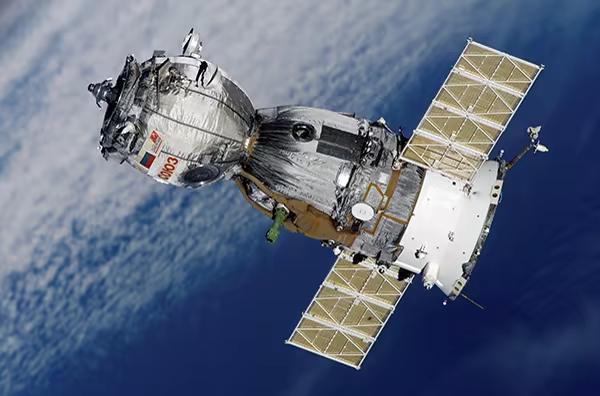
Laboratory scenario 1: Traveling in the lunar system
You will find yourself in the satellite control room and can observe this beautiful planet in the geostationary satellite orbit. You will see the Himalayas, American metropolitan areas, Amazon forests and densely changing clouds. We have shaped the earth that simulates the world with extremely high resolution! Of course, there is also the moon. You will experience the Apollo landing on the moon, come to the surface of the moon in person, see countless impact craters, and experience the special gravity field of the moon (far lower than that on the earth). Please remember not to fall into a meteorite Impact craters, because some meteor impact craters are several kilometers deep. Together with your children, you can observe the earth’s terrain, clouds and the bright lights of the night city from a completely different perspective.
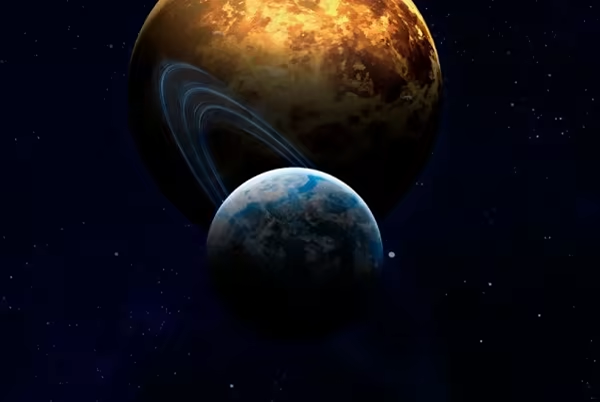
Experimental scenario 2: Wanderers in the solar system
We are used to being numb and chasing fame and fortune. When do we really calm down and take a look at the world we live in? Let go of your worries and drive your spaceship to travel through the solar system and explore the planets.
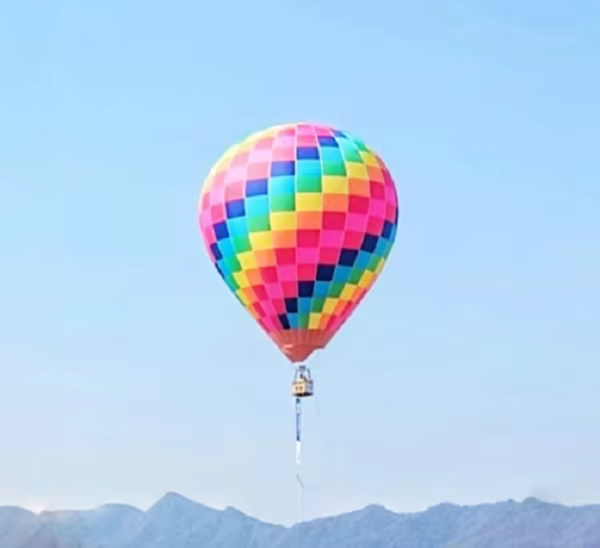
Lab Scene 3: Travel around the world in a hot air balloon
Travel in a hot air balloon and enjoy the colorful world, such as:
Castles on the island, volcanic eruptions, urban ruins, eastern villages, etc.; here you can move the hot air balloon through the keys on the computer keyboard.
We will continue to add more attractions, and then release new updates.
Experimental scenario 4: Traveling at 80% speed of light
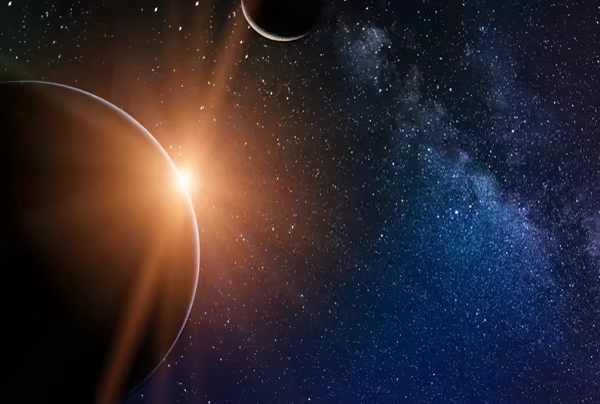
This is a simulated laboratory that can take you to travel in a world where the speed of light is slow. This allows people to have a direct experience of the special theory of relativity, which has the same spirit as George Gamow's "Mr. Tompkins Adventure" (1939). We have experienced various relativistic effects (for example, length contraction, time dilation, Doppler shift, optical aberration) during travel-to gain insights and deepen our intuition for the basic concepts of special relativity.
The laboratory contains 4 sub-games. Through these sub-games, you can experience the magnificence of the universe, the beauty of the earth, the spectacle of the moon and the completely different world you see while driving a spaceship at a speed close to the speed of light. The influence of relativity. Our team comes from the California Institute of Technology and the Department of Physics at Oxford University, and integrates physical science formulas into visual effects.
Laboratory scenario 1: Traveling in the lunar system
You will find yourself in the satellite control room and can observe this beautiful planet in the geostationary satellite orbit. You will see the Himalayas, American metropolitan areas, Amazon forests and densely changing clouds. We have shaped the earth that simulates the world with extremely high resolution! Of course, there is also the moon. You will experience the Apollo landing on the moon, come to the surface of the moon in person, see countless impact craters, and experience the special gravity field of the moon (far lower than that on the earth). Please remember not to fall into a meteorite Impact craters, because some meteor impact craters are several kilometers deep. Together with your children, you can observe the earth’s terrain, clouds and the bright lights of the night city from a completely different perspective.
Experimental scenario 2: Wanderers in the solar system
We are used to being numb and chasing fame and fortune. When do we really calm down and take a look at the world we live in? Let go of your worries and drive your spaceship to travel through the solar system and explore the planets.
Lab Scene 3: Travel around the world in a hot air balloon
Travel in a hot air balloon and enjoy the colorful world, such as:
Castles on the island, volcanic eruptions, urban ruins, eastern villages, etc.; here you can move the hot air balloon through the keys on the computer keyboard.
We will continue to add more attractions, and then release new updates.
Experimental scenario 4: Traveling at 80% speed of light
This is a simulated laboratory that can take you to travel in a world where the speed of light is slow. This allows people to have a direct experience of the special theory of relativity, which has the same spirit as George Gamow's "Mr. Tompkins Adventure" (1939). We have experienced various relativistic effects (for example, length contraction, time dilation, Doppler shift, optical aberration) during travel-to gain insights and deepen our intuition for the basic concepts of special relativity.