
...INDIE
Astro VR
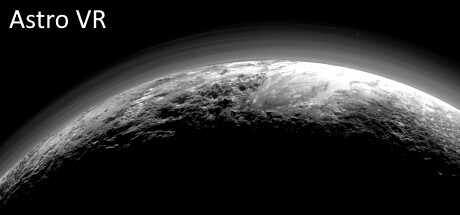
Freely travel among the stars and planets in this made for VR astronomy simulation. Experience space from some of the smallest solar system bodies to our largest planets. Or leave the solar system to explore strange new worlds orbiting stars so distant it takes light thousands of years to get here.
Developer
Publisher
Unknown
Release
June 14, 2024
2 years and 94 days ago
Steam Reviews
Positive21 reviews100.0%
Game contextLatest: IGF Team
| ContextThe evidence factors used to assess whether this game belongs on IndieGame.Fan. | Status | Notes Latest Contributor: IGF TeamEdit notes |
|---|---|---|
Updated: Jul 11, 2026Developer scaleThe operating scale of the game's developer. | ||
Media
18 itemsAbout the Game
Travel among the stars and planets In this made for VR astronomy simulation. Within the solar system you can visit all the planets and moons as well as many asteroids, trans-Neptunian objects, and other small solar system bodies. Outside the solar system, go to thousands of stars and their exoplanets. Also works on flat screen with keyboard and mouse.
SIMULATION
All the solar system objects sizes and locations are based on accurate and up to date information. Where actual images are available you will see the correct texture or, if detailed information is available, a reasonable extrapolation is used. The orientation of the planets is correct relative to the solar system and the solar system itself is oriented correctly to the background stars.
Star color, brightness, size and position are taken directly from available data or are calculated. There are thousands of stars and exoplanets to explore. The habitability zone of each star is calculated and the exoplanets within it are textured appropriately for size, age, and rotation. As you explore you will see text for stars that are known to have planets as well as planets that are within the habitability zone.
Black holes have mass from the latest sources, size and event horizon assume a rotating black hole. Accretion disk rotation speed and doppler beaming effect are simulated along with the gravitation distortion of the background stars.
Objects move with time. Set a time scale and observe planets, moons, asteroids, etc. move in orbits determined by ephemeris data from JPL. See the motion of moons around Jupiter or the Earth around the moon, or the entire system around the sun. Time can move forward or backward and positions are extrapolated for time before or after the dataset.
DATA
Every object is labeled with an option to turn off the text. In addition, detailed information on each object can be displayed. When available, we collect data on position and orbits, size, mass, temperature, magnitude, luminosity, inclination, and more. You can do side by side comparisons with the sun, Jupiter, Earth, and the moon.
Currently there are:
6100 Star Systems
6720 Individual Stars, 16 black holes, 7 neutron stars
8 Planets
222 Moons
91 Minor Planets
5404 Exoplanets
9 Spacecraft
There will be more.
VR EXPERIENCE
You may freely move among all the stellar objects with only two controls. Left controller thumbpad/stick for movement, right to zoom. Separate scales for object size and distance allow you to see the entire solar system within arms length or you may zoom in to where size and distance scales are the same.
AR EXPERIENCE
Terrible. It is possible to set a webcam (including from some headsets) as the background. Typically this is fuzzy and laggy. Your results may vary, but probably not.
Currently:
Min Scale Distance: 1 meter = 2 light years.
Max Scale (both): 1 meter = 1 meter
YouTube Videos
Most viewedNo videos are available for this game yet.
User Comments
Join the conversation in this game’s community chat.