

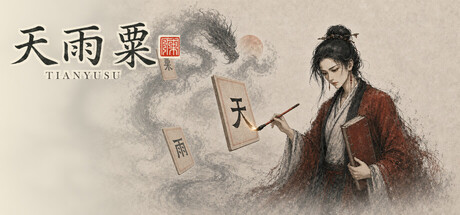
天雨粟
Break glyphs into radicals, compose them into Chinese characters, and cast every word as a card. An ink-wash roguelike deckbuilder: five script styles, a three-act campaign, hanging characters that live between turns, and verse-linked combos against demons born from corrupted ink.
Developer
Publisher
Release
Coming Soon
Steam Reviews
No reviews yet
Does this feel indie?
Vote based on whether this game feels indie to you. You can change your vote at any time. Results earn an IGF score after 10 accepted votes.No votes yet
Game contextLatest: IGF Team
| ContextThe evidence factors used to assess whether this game belongs on IndieGame.Fan. | Status | Notes Latest Contributor: IGF TeamEdit notes |
|---|---|---|
Media
10 itemsAbout the Game
Every Character Is a Card
What would you write with "口" and "天"?In Tian Yu Su you never draw a finished spell — you draw radicals and strokes. Set them into the inkstone, compose a real Chinese character by hand, and let its meaning become an attack, a guard, a transformation or a chained verse. The same pieces can resolve into different characters, and a different character can reshape the whole turn. You are not searching your deck for the one prescribed answer; you are writing the answer this run needs out of the ink and the hand you actually have.
Let a Written Word Live Past the Turn
A completed character does not vanish when it resolves. Hang it on the inkstone and it can become material for the next word, or link with a later character to finish a line of verse. Borrow it, keep it, hold your brush, or gamble on an unfinished composition — every stroke leaves evidence for the turns ahead, and ink-born demons will hunt that evidence down.Five Scripts, Five Ways to Build
- Regular — stabilizes each composition and turns structure into protection.
- Running — carries leftover ink and unfinished cards across turns.
- Seal — stores what you have already written and reprints that power from the seal casket.
- Clerical — records a verdict in vermilion and turns repeated auditing into execution.
- Cursive — converts failed strokes into momentum and reconnects scattered meanings.
A Three-Act Codex You Keep Rewriting
Cross the Drought of Torn Scrolls, the Ink Prison of Eroded Steles and the Forbidden Court of the Celestial Codex. Each act boss is visible before you set out, so you choose between the safe line and the greedy line through battles, elites, events, bookshops, treasures, rests and character-forging stations. Beat the act boss, pick a seal with an explicit gain and an explicit cost, then carry the same living deck into the next act.The Demons Attack Your Language
Enemies do more than cut your vermilion. They eat radicals, swallow hanging characters, stain your draw pile, dry your ink and copy the word you just finished. Read intents, order your targets and build enough redundancy that your engine can restart after it has been broken.A Living Ink-Wash Scroll
Paper is the light. Corrupted ink is the enemy. Cinnabar is reserved for danger and judgment. Characters, demons, interface, verse cinematics and all three acts obey one tactile language of xuan paper, wet ink bloom and broken brush fibers, and every heavy hit, failed composition and completed verse reads back in brushwork.The Codex Allows Only One Name for Each Thing
Every meaning it deleted bled out as corrupted ink, and the nameless came back through the gap. You are a character mender walking a three-act world painted on living paper.Break glyphs into the inkstone. Let the written word become the spell.
This time you are not writing the standard answer — you are writing the stroke that gives the world its names back.