
...INDIE
Alembic
A falling-sand sandbox built on the **real periodic table**. Every element has genuine physical properties, and reactions emerge from real chemistry — rust iron, ignite thermite, run a galvanic cell, split a uranium pile to criticality. Discover it all in an encyclopedia that fills as you play.
Developer
Publisher
Release
September 9, 2026
8 days ago
Steam Reviews
5 user reviews5 reviews80.0%
Game contextLatest: IGF Team
| ContextThe evidence factors used to assess whether this game belongs on IndieGame.Fan. | Status | Notes Latest Contributor: IGF TeamEdit notes |
|---|---|---|
Media
10 itemsAbout the Game
THE PERIODIC TABLE IS YOUR SANDBOX
Alembic is a falling-sand laboratory built on the real periodic table.
Pour elements together. Heat them, cool them, dissolve them, electrify them, compress them, irradiate them and see what happens.
Reactions emerge from physical and chemical properties rather than fixed crafting recipes — and now you can build machines around those reactions, route matter through entire systems, generate electricity, and experiment with nuclear physics.
CHEMISTRY YOU CAN ACTUALLY PLAY WITH
Every element carries properties derived from the real thing: density, phase transitions, atomic mass, electronegativity, valence and more.
Drop sodium into water and watch it react. Grind aluminium over iron oxide and ignite thermite. Dissolve salts, distill solutions, plate metals through electrolysis, form alloys and amalgams, oxidize iron into rust, melt silica into glass, and push materials through phase changes.
There is no recipe book deciding that “A + B = C.” The simulation asks what the materials are, what state they are in, and what environment you put them in.
DON'T JUST MAKE REACTIONS. BUILD SYSTEMS AROUND THEM.
Pipes carry liquids and gases through the world. Fans create real pressure gradients and drive flow. Filters separate phases. Conveyors move loose matter. Thermal plates heat and cool what touches them. Sensors watch the simulation and control equipment.
Generators don't simply produce power because you placed one. Matter has to move through them. Drive a fast gas stream with a fan, drop water through one, or build a steam cycle and turn heat into electricity.
The machines aren't operating on a separate automation layer. They interact with the exact same particles, heat, pressure and electricity as everything else in the sandbox.
BUILD A REACTOR. OR ACCIDENTALLY BUILD A BOMB.
Radioactivity is part of the simulation, not a canned explosion effect.
Radioactive materials emit radiation. Neutrons travel through matter, lose energy in moderators, scatter, reflect from suitable materials and disappear into neutron absorbers. Uranium and other nuclear fuels can undergo fission, producing heat and more neutrons.
Geometry matters. Fuel arrangement matters. Moderation matters. Reflection matters. Control material matters.
Keep the neutron population under control and you can sustain fission long enough to heat coolant, make steam and extract power.
Let the chain run away and the microscopic simulation hands off to something much less microscopic.
Yes, the molten lead raining out of the wreckage is simulated too.
ONE WORLD. INTERCONNECTED PHYSICS.
Heat doesn't stop being heat because it entered a pipe. Pressure doesn't disappear because it crossed a machine. Matter doesn't become decorative when it enters a generator.
Water finds its level. Steam expands. Gas compresses inside sealed spaces. Dense materials sink beneath lighter ones. Hot objects conduct into their surroundings. Electrical resistance generates heat. Pressure can rupture structures. Explosions throw matter according to the material standing in their way.
Those systems overlap — which means solving one problem can create another.
Liquids that actually behave
Water finds its level. Through pipes, under walls, around corners, like real communicating vessels.
Trap gas under a diving bell and the sea compresses it; crack the seal and it erupts. Mercury is so dense that nearly everything you drop in it floats back out.
Your window is a lab flask
Hold Shift and shake the actual game window.
The contents feel every jerk and stop: powders slam into walls, leap for the lid, and fold into each other; liquids slosh, surge, and swallow whatever you stirred up. It's not a mini-game. It's the mixing tool.
DISCOVER WHAT THE WORLD CAN DO
You don't begin with a completed encyclopedia.
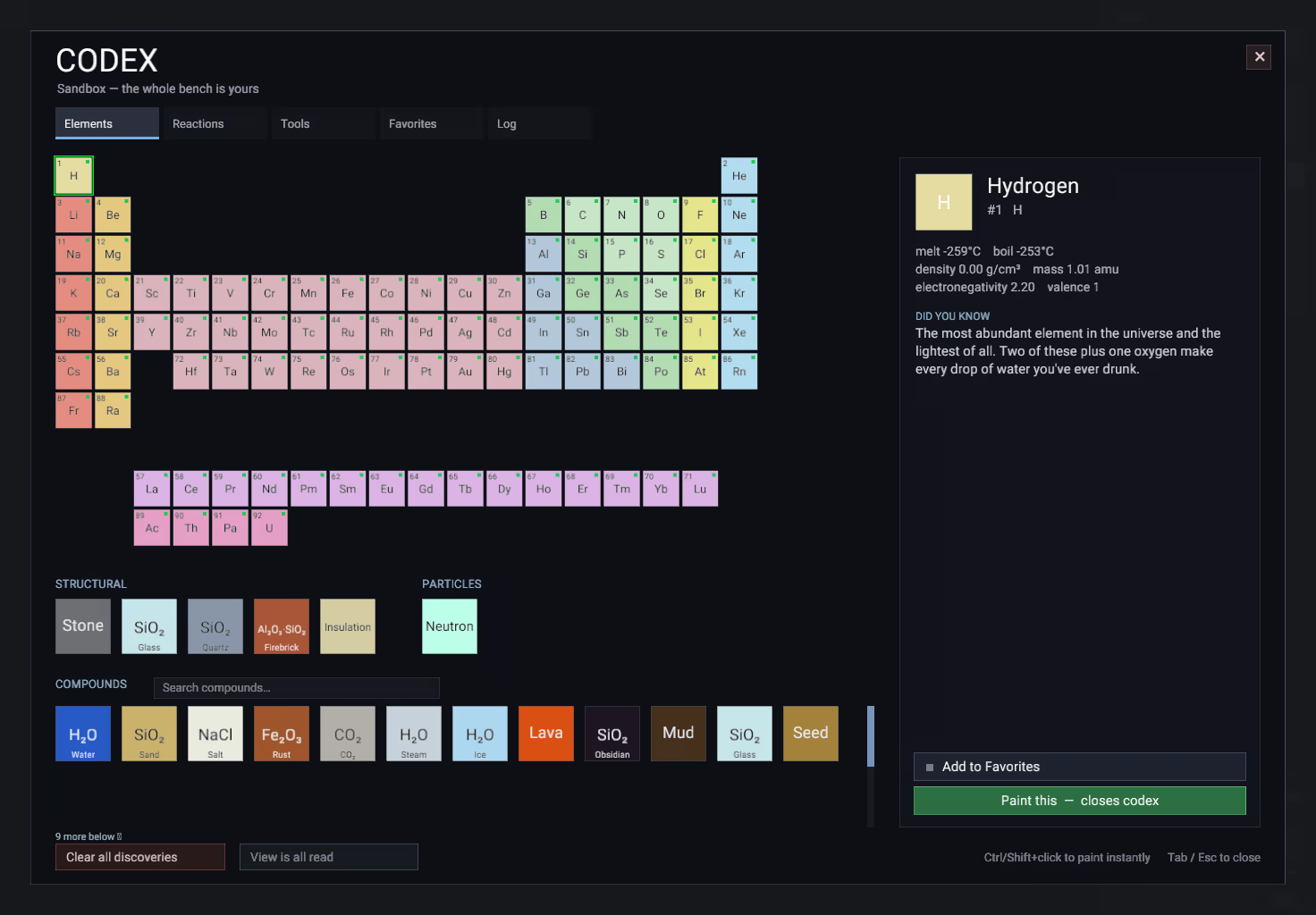
Experiments fill the Codex as you play: elements, reactions, phenomena and tools are recorded as you encounter them. Much of the periodic table opens through actual discoveries rather than a conventional progression tree.
If a completely blank sandbox isn't enough direction, Challenges give you experiments to pursue — from distillation and metallurgy to chemistry, engineering and nuclear destruction — with Bronze, Silver and Gold targets.
Or enable Sandbox mode and take the entire laboratory immediately.
A SANDBOX FULL OF REAL PHENOMENA
Chemistry: combustion, oxidation, thermite, acid-base reactions, electrochemistry, alloys, amalgams, dissolution, crystallization and distillation
Fluids & pressure: buoyancy, communicating vessels, compression, vacuum, steam expansion, pressure-driven flow and structural rupture
Electricity: batteries, galvanic cells, electrolysis, resistance heating, high-voltage arcs and generators
Machines: fans, pipes, filters, conveyors, thermal plates, generators, sensors and material spawners
Nuclear physics: radioactive decay, alpha radiation, neutron production, moderation, absorption, reflection, fission, fuel burnup and criticality
Materials: melting, boiling, freezing, condensation, heat conduction, density and phase-dependent behavior
Tools: heat, pressure, vacuum, pipetting, mortar/grinding, prefabs — and physically shaking the game window
Alembic is a laboratory where the experiment is whatever you decide to build next.
YouTube Videos
Most viewedNo videos are available for this game yet.
User Comments
Join the conversation in this game’s community chat.