

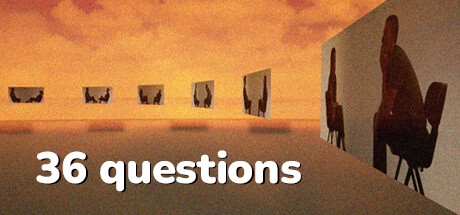
36 Questions
36 people. 36 questions designed to make them fall in love. One virtual park dedicated to this moment in time.
Developer
Publisher
Release
August 9, 2023
2 years and 359 days ago
Steam Reviews
Awaiting reviews
Does this feel indie?
Vote based on whether this game feels indie to you. You can change your vote at any time. Results earn an IGF score after 10 accepted votes.No votes yet
Game contextLatest: IGF Team
| ContextThe evidence factors used to assess whether this game belongs on IndieGame.Fan. | Status | Notes Latest Contributor: IGF TeamEdit notes |
|---|---|---|
Media
6 itemsAbout the Game
36 people, most of them meeting for the first time. Answering 36 questions that were designed to make them fall in love with each other. This virtual park is dedicated to this moment in time when their bodies and souls met to discuss everything - from their daily quirks to their deepest thoughts.
The experiment was inspired by the studies of the scientist Arthur Aron.
Every couple has their own 36 spaces, for every question one space.
Most of the couples were matched on a blind date, but some year-long couples also applied to deepen their relationship.
NARRATIVE
The narrative structure of this work is based on the structure and dramaturgy of the 36 questions designed by the psychologist Arthur Aron. As the questions progress, they get more intimate and intense. As the order of the questions is important, the order of rooms in gallery is therefore linearly set accordingly.
INTERACTIVITY
Visitor can move freely through this space. Interactivity serves the purpose of intensifying the sense of being inside the artwork. After the visitor enters a certain room, video projections automatically start. The video projections are on the other side of the room so the visitor can choose the distance from which they watch the video.
SPATIALITY
All the spaces are monumental: this is to evoke a feeling of sacredness of the space - as was done by countless sacral buildings throughout history. The absence of roof and the open vertical connection with the sky above enhances this feeling. Symmetry and linear spatial configuration make this otherwise complex space clear and intuitive. The movement direction follows the linear order of questions.
DOCUMENTARINESS
The only instructions the participants were given were those to stay natural, spontaneous, with no time or other limitations: they can discuss a certain question for as long as they want. This spontaneousness guarantees an authentic testimony of a moment in time, of two people going through an experience together. Besides this qualitative value, there is also a significant quantitative value: a total of 19 couples and around 35 hours of video material make for a worthy material for a sociological, psychological, anthropological etc. study.
VISUALITY
This work is consciously using its digital nature as the core sensibility and aesthetics. Materials, scale, color - are all enhancing the general surreal and sacral feeling, while adding the digital, artificial touch.
The experiment was inspired by the studies of the scientist Arthur Aron.
Every couple has their own 36 spaces, for every question one space.
Most of the couples were matched on a blind date, but some year-long couples also applied to deepen their relationship.
NARRATIVE
The narrative structure of this work is based on the structure and dramaturgy of the 36 questions designed by the psychologist Arthur Aron. As the questions progress, they get more intimate and intense. As the order of the questions is important, the order of rooms in gallery is therefore linearly set accordingly.
INTERACTIVITY
Visitor can move freely through this space. Interactivity serves the purpose of intensifying the sense of being inside the artwork. After the visitor enters a certain room, video projections automatically start. The video projections are on the other side of the room so the visitor can choose the distance from which they watch the video.
SPATIALITY
All the spaces are monumental: this is to evoke a feeling of sacredness of the space - as was done by countless sacral buildings throughout history. The absence of roof and the open vertical connection with the sky above enhances this feeling. Symmetry and linear spatial configuration make this otherwise complex space clear and intuitive. The movement direction follows the linear order of questions.
DOCUMENTARINESS
The only instructions the participants were given were those to stay natural, spontaneous, with no time or other limitations: they can discuss a certain question for as long as they want. This spontaneousness guarantees an authentic testimony of a moment in time, of two people going through an experience together. Besides this qualitative value, there is also a significant quantitative value: a total of 19 couples and around 35 hours of video material make for a worthy material for a sociological, psychological, anthropological etc. study.
VISUALITY
This work is consciously using its digital nature as the core sensibility and aesthetics. Materials, scale, color - are all enhancing the general surreal and sacral feeling, while adding the digital, artificial touch.